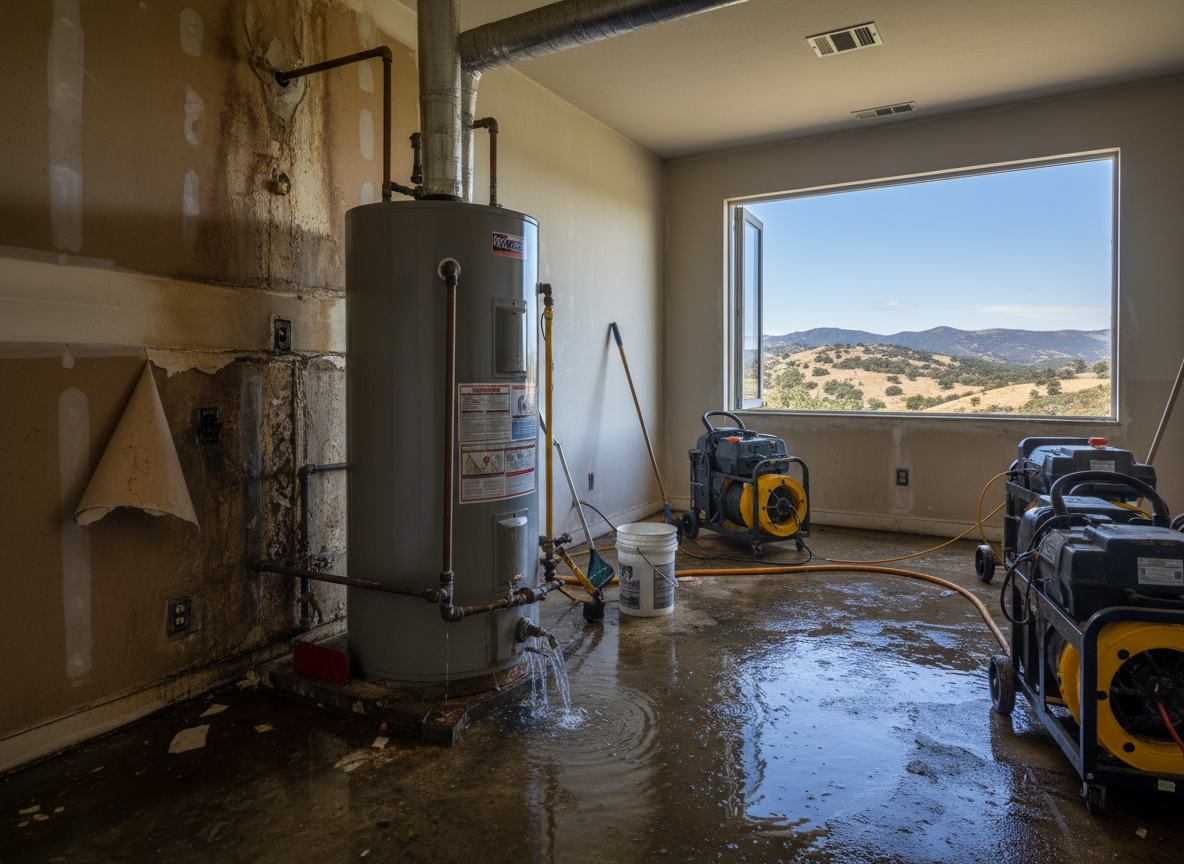
A house built in the 1970s has had its plumbing working for roughly half a century. Even where pipes have been replaced, water heaters, angle stops, toilet supply lines and washing machine hoses are common failure points. When one gives way, water can run inside a wall or under a cabinet for hours before anyone sees it.
Water heaters deserve special attention in Southern California. Health and Safety Code section 19211 requires residential water heaters to be braced, anchored or strapped so they resist falling or shifting in an earthquake. A tank that tips or rusts through can empty into a garage, closet or laundry room. Shut the cold supply valve on top of the tank and turn off its gas or power before anyone starts cleaning.
Slow leaks are harder to spot. The California Department of Public Health lists the warning signs as visible mold, a musty smell, stains, peeling paint, warped floors, rotting wood and materials that feel damp. A restoration team can use moisture meters and small inspection openings to map how far the water traveled, which tells you how much has to be dried or removed.
Two trades are often involved. A plumber stops and repairs the leak; the restoration team dries and repairs the building. Before hiring either, you can look up a contractor's license on the CSLB website. Ask the restoration team to photograph the damage and record moisture readings at each visit, because your insurer will want to know how long the leak ran.
On coverage, the NAIC says water damage from a home's plumbing is typically covered by homeowners insurance, while the Insurance Information Institute notes that damage caused by lack of maintenance is not. A sudden burst is usually treated differently from a drip that went on for months. The Institute reports that about one in 60 insured homes files a water damage or freezing claim each year, averaging $15,400 from 2019 to 2023.
If the claim stalls, California's fair claims rules require insurers to acknowledge it within 15 calendar days, decide within 40 days of receiving proof of claim and pay within 30 days of accepting it. The Department of Insurance consumer hotline is 1-800-927-4357.
After the leak is repaired, the wet floors and walls still need water extraction and drying, and growth that started inside a cabinet or wall is handled under mold remediation. Owners of older houses in West Hills and Calabasas face the same aging-plumbing risks.
Pipe and Water Heater Leaks Services We Offer
✓Water Heater Failure Cleanup
Garage, closet and laundry room cleanup after a tank leaks or tips, with wet drywall and baseboards dried or replaced.
✓Supply Line and Fixture Leak Drying
Water from angle stops, toilet lines and appliance hoses traced and dried before it spreads.
✓Hidden Wall Leak Investigation
Moisture meters and small openings show where a slow leak traveled so only damaged materials come out.
How it works
- 1
Stop and isolate
The water is shut off at the fixture or main and power is cut to wet areas.
- 2
Map the moisture
Meters show how far water reached through walls, floors and cabinets.
- 3
Remove and dry
Soaked materials that cannot dry in time are removed and drying equipment is set.
- 4
Document for the claim
Readings and photos are kept, then repairs follow once everything is dry.